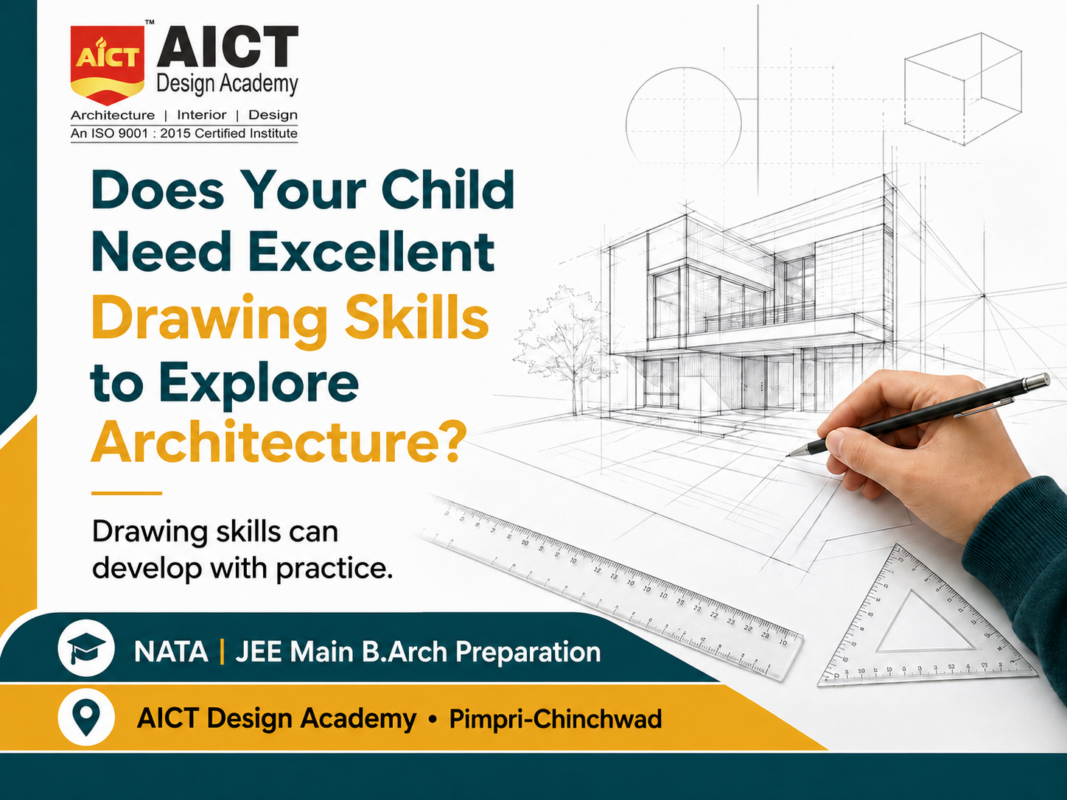
Architecture student sketching a building while learning about drawing skills for NATA and JEE Main B.Arch preparation

Is Good Drawing Necessary to Become an Architect?

Many parents believe that a child must be an excellent artist to pursue Architecture. This assumption often creates confusion when students express interest in becoming Architects.Drawing is certainly an important part of Architecture education and entrance preparation, but it is only one of several abilities required. Observation, visual thinking, spatial understanding, creativity, Mathematics, logical reasoning and problem-solving also play an important role.

1. Why Parents Associate Architecture Only with Drawing

When parents think about Architecture, they often imagine an Architect sitting at a drawing board and preparing detailed building sketches. This is understandable because drawing is one of the most visible parts of the profession. However, Architecture involves much more than sketching. Architects study how people use spaces, how buildings respond to their surroundings, how materials are selected and how design ideas can be converted into practical structures. Drawing is a method of communicating ideas. It helps an Architect explain the shape, proportion, layout and character of a building. A student may not have advanced drawing skills initially but may still have strong observation, imagination and problem-solving abilities. Parents should therefore avoid judging a child’s Architecture potential only by looking at their present drawing level.

2. Is Architecture the Same as Fine Art?

Architecture and fine art are related to creativity, but they are not the same field.Fine art may focus mainly on personal expression, visual beauty, emotions or artistic communication. Architecture combines creativity with function, safety, technology, materials, construction and human requirements.

An Architect must think about questions such as:

  • Who will use the building?
  • What activities will take place inside?
  • How will people enter, move and exit?
  • How much light and ventilation is required?
  • Which materials are suitable?
  • Is the design practical and safe?
  • How will the building respond to its surroundings?

A beautiful drawing alone cannot solve these questions. Architecture requires the ability to develop creative ideas and apply them to real-life needs.

3. What Type of Visual Skills Do Architecture Aspirants Need?

Architecture aspirants need visual skills that help them understand and communicate spaces, forms and relationships.

Important visual skills include:

Observation

Students should learn to notice details such as shape, size, texture, proportion, light and shadow.

Spatial thinking

This involves understanding how objects relate to one another in three-dimensional space. Students may need to imagine how an object looks from the front, side, top or another angle.

Proportion

Proportion helps students understand the relationship between the sizes of different parts of an object, building or drawing.

Perspective

Perspective helps represent three-dimensional objects on a two-dimensional surface. It allows students to show depth, distance and position.

Visual communication

Students should be able to communicate an idea clearly through sketches, diagrams, forms, symbols or drawings.

These skills develop gradually through observation, guided practice and regular application.

4. Why Observation Is Important

Architecture begins with understanding the world around us.

Students can develop visual awareness by observing:

  • Buildings and facades
  • Doors, windows and balconies
  • Roads and public spaces
  • Furniture and everyday objects
  • Light and shadows
  • Human movement
  • Natural forms and patterns
  • Materials, textures and colours

Observation helps students move beyond simply looking at something. They begin to ask:

  • What shape is this?
  • How is it proportioned?
  • How does it connect with other elements?
  • How does light fall on the surface?
  • How can I represent it through a sketch?

This habit supports visual thinking and design awareness. A student who regularly observes and sketches everyday objects can gradually become more comfortable with representing forms and spaces.

Parents can encourage observation through simple activities such as visiting buildings, discussing the layout of a room or asking the child to sketch an object from different angles.

5. Understanding Proportion and Perspective

Proportion and perspective are two important foundations of architectural drawing.

Proportion

Proportion refers to the relationship between the size of different elements. For example, when sketching a chair, the height of the back, size of the seat and thickness of the legs should appear reasonably related.

If the proportions are incorrect, the object may look unnatural even if the drawing is neat.

Perspective

Perspective helps students represent depth. It allows them to show whether an object is near or far and how lines appear to meet as they move into the distance.

Students may gradually practise:

  • One-point perspective
  • Two-point perspective
  • Simple room interiors
  • Roads and buildings
  • Furniture arrangements
  • Objects viewed from different angles

These concepts do not become perfect in one day. Regular practice helps students understand how three-dimensional forms can be represented on paper.

6. Can Drawing Skills Improve Through Practice?

Yes, many aspects of drawing can improve through structured and consistent practice.

Students can develop their drawing ability by practising:

  • Basic lines and shapes
  • Forms such as cubes, cylinders and cones
  • Object sketching
  • Perspective
  • Light and shadow
  • Proportion
  • Composition
  • Memory drawing
  • Time-bound exercises

Improvement does not come only from drawing repeatedly. Students also need to understand their mistakes.

For example, a mentor can help a student identify whether the problem is related to:

  • Incorrect proportion
  • Weak perspective
  • Poor observation
  • Incomplete details
  • Lack of time management
  • Unclear representation

Regular practice combined with guidance can make improvement more organised and measurable. Students should focus on progress rather than comparing their first drawings with someone else’s advanced work.

7. Importance of Creativity and Problem-Solving

Architecture is a creative profession, but creativity in Architecture is not limited to producing attractive drawings.

Architectural creativity involves finding suitable solutions to real problems. A designer may need to plan a comfortable home on a small plot, improve movement within a building or create a useful public space within limitations.

Students can develop creative thinking by asking:

  • Can this object be used differently?
  • How can I improve this space?
  • What other solution is possible?
  • How can I make the design more comfortable?
  • How can I solve this problem with limited materials or space?

Problem-solving activities, model-making, design exercises, puzzles and observation tasks can help students develop this mindset.

A student does not need to produce extraordinary ideas immediately. The important quality is the willingness to explore different possibilities and learn from feedback.

8. Role of Mathematics and Logical Ability

Mathematics is an important part of Architecture education and entrance preparation. Students should not assume that Architecture is only a creative field with no connection to Mathematics.

Mathematics may support understanding of:

  • Measurement
  • Scale
  • Proportion
  • Geometry
  • Shapes and forms
  • Angles
  • Areas and volumes
  • Logical relationships

Logical ability also helps students analyse information, identify patterns and arrive at suitable solutions.

A student who is interested in drawing but is uncomfortable with Mathematics should not immediately reject Architecture. Instead, the student can identify the specific areas that require improvement and work on them gradually.

A balanced Architecture entrance preparation program should include drawing, visualisation, aptitude and Mathematics practice.

9. How Guided Mentoring Supports Improvement

Self-practice is useful, but students can progress more efficiently when they receive proper guidance.

A mentor can help students:

  • Understand the expected level of preparation
  • Learn drawing methods step by step
  • Correct proportion and perspective mistakes
  • Improve speed and accuracy
  • Review test performance
  • Identify weak areas
  • Maintain regular practice
  • Build confidence gradually

Guided mentoring does not mean completing the work for the student. It means helping the student understand the process, correct mistakes and practise with direction.

Parents should look for a learning environment where students receive regular practice opportunities, constructive feedback, mentoring and exposure to different types of questions and exercises.

10. How Students in Classes 8–10 Can Explore Architecture

Students in Classes 8–10 do not need to begin intensive entrance preparation. This stage can be used for career exploration and understanding the child’s interest.

Parents can encourage students to try:

  • Freehand sketching
  • Drawing everyday objects
  • Building simple paper or cardboard models
  • Exploring shapes and forms
  • Solving visual puzzles
  • Observing buildings and public spaces
  • Creating room layouts
  • Taking photographs of interesting architectural details
  • Discussing how people use different spaces

The objective is not to put examination pressure on the child. It is to understand whether the student enjoys:

  • Drawing and visual communication
  • Buildings and spaces
  • Creativity
  • Observation
  • Logical thinking
  • Problem-solving

Early exploration can help parents and students make more informed decisions after Class 10.

11. What Students Learn During NATA and JEE Main B.Arch Preparation

NATA and JEE Main Paper 2A B.Arch are important examination routes associated with Architecture admissions. However, eligibility conditions, syllabi, examination formats and admission requirements may change from year to year. Students should always verify the latest information through the official examination websites.

The official NATA website describes the examination as assessing areas such as cognitive skills, visual perception, aesthetic sensitivity, logical reasoning and critical thinking, along with other Architecture-related abilities.

The official JEE Main website provides current notices and information related to Paper 2A B.Arch.

A structured preparation program commonly helps students work on:

Drawing and visual communication

Students practise observation, proportion, perspective, composition and representation.

Visualisation and spatial thinking

Students learn to understand forms, objects, views and relationships in space.

Design aptitude

Students work on visual reasoning, design awareness and creative problem-solving.

Mathematics

Students revise relevant concepts and practise application-based questions.

Logical reasoning

Students learn to analyse patterns, relationships and visual information.

Mock tests and previous-year questions

Timed practice helps students become familiar with question-solving pressure and identify areas needing improvement.

Test analysis

Students review incorrect answers, unattempted questions, time-consuming problems and topics requiring revision.

The purpose of preparation is not only to complete more questions. It is to develop the required skills through regular practice, analysis and mentoring.

12. When Parents Should Consider Career Counselling

Parents should consider career counselling when:

  • The student is interested in Architecture but the family lacks information
  • Parents are unsure about NATA and JEE Main B.Arch
  • The child’s drawing level is creating confusion
  • The student is comparing Architecture with Engineering, Medical or other fields
  • The family wants to understand the required subjects and skills
  • The student is in Classes 8–10 and wants to explore future options
  • The student is struggling to select a preparation plan
  • Parents want to understand whether the child’s interests match the field

Good counselling should be an open discussion—not pressure to choose a particular career.

A counselling session can help parents and students discuss the student’s interests, current abilities, academic subjects, preparation requirements and realistic next steps.

Conclusion

Excellent drawing skills can be helpful for Architecture, but they are not the only requirement. Students also need observation, visual thinking, spatial understanding, creativity, Mathematics, logical ability and a willingness to practise.

Drawing skills can develop over time when students receive structured exercises, regular practice and constructive mentoring.

Parents from Pimpri-Chinchwad and Pune can visit AICT Design Academy with their child for personal Architecture career counselling and guidance about NATA and JEE Main B.Arch preparation.

Location

Visit AICT Design Academy, Pimpri-Chinchwad, to understand whether Architecture may be a suitable career option for your child and to discuss a structured entrance preparation program.