Architecture career guide with NATA, JEE Main B.Arch and admission information for students and parents

Is Architecture the Right Career for Your Child? A Complete Guide for Parents

Architecture Career Guide for Parents: Skills, NATA, JEE Main B.Arch and Admissions

When a child says, “I want to become an Architect,” many parents have questions.

Is Architecture only about drawing? Does the student need excellent artistic skills? What subjects are required? How do NATA and JEE Main B.Arch fit into the admission process? When should preparation begin?

Architecture can be a meaningful career option for students who are interested in buildings, spaces, creativity, observation, Mathematics and problem-solving. However, parents should understand the field carefully before making a decision.

This guide explains the important questions parents and students should consider while exploring Architecture as a career.

1. Why Should Parents Understand Architecture Before Deciding?
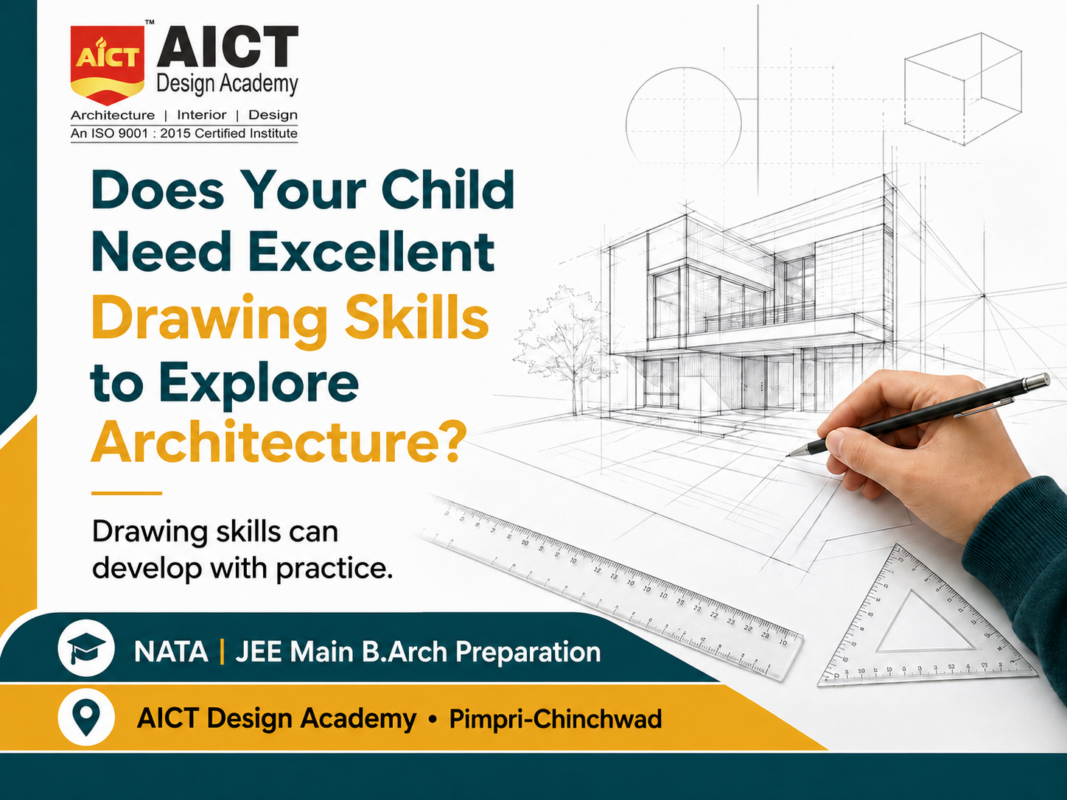
Parents should understand what Architects study, what work they do, which skills are required and how the admission pathway works.

Many parents are familiar with Engineering, Medical and Pharmacy careers, but may have limited information about Architecture. Proper understanding helps parents guide their child based on facts rather than assumptions or comparisons.

Career decisions should be based on the student’s interest, aptitude, academic background and willingness to learn.

2. What Does an Architect Actually Do?

An Architect plans and designs buildings and spaces. Their work is not limited to preparing drawings.

Architects may work on:

  • Residential buildings
  • Commercial spaces
  • Educational institutions
  • Public buildings
  • Urban spaces
  • Interior and spatial planning
  • Building documentation and coordination

An Architect studies client requirements, develops design concepts, prepares drawings, considers materials and coordinates with different professionals involved in a project.

3. What Interests May Indicate an Inclination Towards Architecture?

A student may explore Architecture if they show interest in:

  • Buildings and spaces
  • Drawing and sketching
  • Observation
  • Creativity
  • Geometry and Mathematics
  • Models and making things
  • Photography and visual details
  • Problem-solving
  • Understanding how things are designed

A student does not need to demonstrate all these interests. The purpose is to understand whether the student enjoys exploring ideas, spaces and design-related problems.

4. Is Excellent Drawing Required from the Beginning?

No. A student does not need to be an expert artist before exploring Architecture.

Architecture-related drawing is connected with observation, proportion, perspective, visualisation and communication. These skills can improve with regular practice and proper mentoring.

Students can begin with simple activities such as:

  • Sketching everyday objects
  • Drawing buildings and spaces
  • Understanding light and shadow
  • Practising basic forms
  • Observing proportion and perspective

Interest and willingness to practise are more important than initial perfection.

5. Why Do Creativity and Problem-Solving Matter in Architecture?

Architecture involves solving practical problems through creative thinking.

An Architect may need to consider:

  • How people will use a space
  • How movement will happen
  • Where light and ventilation will come from
  • How materials will be used
  • How to work within site limitations
  • How to balance beauty and function

Therefore, students need both creativity and logical thinking. A design should not only look attractive; it should also be practical and suitable for its users.

6. What Is the Role of Mathematics and Logical Ability?

Mathematics supports several aspects of Architecture, including:

  • Measurement
  • Geometry
  • Scale
  • Proportion
  • Spatial relationships
  • Area and volume
  • Logical reasoning

Students do not need to fear Mathematics, but they should develop a clear understanding of relevant concepts and practise regularly.

Logical ability also helps students analyse situations and find suitable solutions.

7. What Are NATA and JEE Main B.Arch?

NATA and JEE Main B.Arch are important entrance examination pathways associated with admission to eligible Bachelor of Architecture programs.

The exact examination pattern, eligibility criteria, accepted scores and admission process may vary depending on the year, institution and applicable authorities.

Students should understand:

  • Which examinations are relevant to their target colleges
  • What subjects and skills are tested
  • What the current eligibility criteria are
  • How counselling and admission procedures work

The latest official information should always be verified before applying.

8. When Should Entrance Preparation Begin?

Students can begin exploring Architecture through simple observation, creative and sketching activities during Classes 8–10.

More structured preparation can begin during Classes 11 and 12, depending on the student’s academic stage and goals.

Early preparation can provide time to develop:

  • Drawing and visualisation
  • Design aptitude
  • Mathematics
  • Logical reasoning
  • Speed and accuracy
  • Test-taking skills

The preparation plan should be realistic and should not create unnecessary pressure.

9. How Can Students Balance Board Examinations with Entrance Preparation?

Students should prepare a weekly schedule that includes both Board studies and entrance preparation.

The schedule may include:

  • Board subject revision
  • Mathematics practice
  • Drawing sessions
  • Aptitude exercises
  • Previous-year question practice
  • Mock tests
  • Error analysis

Students do not need to study every subject every day. Regular short sessions and proper planning can help maintain continuity.

Parents should encourage consistency without creating constant pressure about marks and comparison.

10. How Can an Aptitude Assessment Help?

An aptitude assessment can help students and parents understand areas such as:

  • Visual thinking
  • Observation
  • Creativity
  • Logical reasoning
  • Spatial understanding
  • Basic design awareness

It can provide useful guidance about the student’s present strengths and areas for improvement.

However, an aptitude assessment should not be treated as the only basis for choosing a career. It should be considered along with the student’s interests, academic background and willingness to learn.

11. What Should Students Understand About Eligibility and Admission Routes?

Students should carefully check:

  • Required subjects
  • Qualifying examination
  • Entrance examination criteria
  • Accepted scores
  • Application dates
  • Counselling process
  • Documents required
  • College-specific requirements

Eligibility rules and admission procedures can change. Students should refer to official examination authorities, counselling bodies and college websites for the latest information.

12. How Should Parents Shortlist Architecture Colleges?

Parents and students should compare colleges based on:

  • Official recognition and admission route
  • Eligibility requirements
  • Curriculum
  • Studio facilities
  • Workshops and practical exposure
  • Faculty and academic environment
  • Location and travel
  • Fees and other expenses
  • Accommodation requirements
  • Student’s long-term goals

A college should not be selected only because it is popular or because friends are joining there.

13. What Educational Expenses Should Parents Consider?

Apart from tuition fees, parents should consider:

  • Admission charges
  • Examination fees
  • Study materials
  • Drawing and model-making materials
  • Software requirements
  • Printing and submission expenses
  • Travel
  • Accommodation
  • Equipment and stationery

A complete financial plan helps parents make a practical and informed decision.

14. Why Should Official Admission Information Be Verified?

Exam patterns, dates, eligibility requirements, participating institutions and admission procedures may change.

Information shared through social media, relatives or unofficial websites may not always be current.

Before applying, students should verify details through:

  • Official examination websites
  • Official counselling authorities
  • College websites
  • Admission notifications

This is especially important for NATA, JEE Main B.Arch and college admission planning.

15. Why Should Students Avoid Career Decisions Based Only on Comparison?

Every student has different interests, abilities and learning preferences.

A student should not choose Architecture only because:

  • A friend is choosing it
  • A relative recommended it
  • It is considered popular
  • Someone else achieved success in it

Similarly, students should not reject Architecture only because they are not currently excellent at drawing.

The right decision should be based on interest, aptitude, preparation and long-term willingness to learn.

16. What Questions Should Students Ask During Counselling?

Students can ask:

  • What do Architects study?
  • What is the difference between NATA and JEE Main B.Arch?
  • Which skills should I improve?
  • How much Mathematics is involved?
  • When should I begin preparation?
  • How can I balance Boards and entrance preparation?
  • Which practice methods are followed?
  • How are tests and mock examinations conducted?
  • What should I consider while selecting a college?
  • What documents and admission steps are required?

Asking questions helps students participate actively in their own career decision.

17. How Should Students Prepare for a Personal Counselling Session?

Students should attend counselling with their parents and be ready to discuss:

  • Their interests
  • Favourite subjects
  • Academic performance
  • Career expectations
  • Concerns about drawing or Mathematics
  • Preferred study schedule
  • Possible Architecture colleges

If available, students may also bring their sketches, creative work or previous academic information.

A counselling session is an opportunity to understand the field clearly and create a realistic preparation plan.

Conclusion

Architecture is more than drawing buildings. It combines creativity, observation, visual thinking, Mathematics, problem-solving, technical understanding and practical planning.

Students do not need to be perfect at the beginning. With interest, regular practice, structured preparation and proper guidance, they can gradually develop the skills needed to explore Architecture.

Parents should support the student by understanding the profession, asking the right questions and making decisions based on individual interest and aptitude.

AICT Design Academy provides personal Architecture career counselling and structured preparation for NATA and JEE Main B.Arch aspirants in Pimpri-Chinchwad and Pune.

Parents and students can visit the institute to understand the Architecture career pathway and suitable preparation options.

Architecture student sketching a building while learning about drawing skills for NATA and JEE Main B.Arch preparation

Is Good Drawing Necessary to Become an Architect?

Many parents believe that a child must be an excellent artist to pursue Architecture. This assumption often creates confusion when students express interest in becoming Architects.Drawing is certainly an important part of Architecture education and entrance preparation, but it is only one of several abilities required. Observation, visual thinking, spatial understanding, creativity, Mathematics, logical reasoning and problem-solving also play an important role.

1. Why Parents Associate Architecture Only with Drawing

When parents think about Architecture, they often imagine an Architect sitting at a drawing board and preparing detailed building sketches. This is understandable because drawing is one of the most visible parts of the profession. However, Architecture involves much more than sketching. Architects study how people use spaces, how buildings respond to their surroundings, how materials are selected and how design ideas can be converted into practical structures. Drawing is a method of communicating ideas. It helps an Architect explain the shape, proportion, layout and character of a building. A student may not have advanced drawing skills initially but may still have strong observation, imagination and problem-solving abilities. Parents should therefore avoid judging a child’s Architecture potential only by looking at their present drawing level.

2. Is Architecture the Same as Fine Art?

Architecture and fine art are related to creativity, but they are not the same field.Fine art may focus mainly on personal expression, visual beauty, emotions or artistic communication. Architecture combines creativity with function, safety, technology, materials, construction and human requirements.

An Architect must think about questions such as:

  • Who will use the building?
  • What activities will take place inside?
  • How will people enter, move and exit?
  • How much light and ventilation is required?
  • Which materials are suitable?
  • Is the design practical and safe?
  • How will the building respond to its surroundings?

A beautiful drawing alone cannot solve these questions. Architecture requires the ability to develop creative ideas and apply them to real-life needs.

3. What Type of Visual Skills Do Architecture Aspirants Need?

Architecture aspirants need visual skills that help them understand and communicate spaces, forms and relationships.

Important visual skills include:

Observation

Students should learn to notice details such as shape, size, texture, proportion, light and shadow.

Spatial thinking

This involves understanding how objects relate to one another in three-dimensional space. Students may need to imagine how an object looks from the front, side, top or another angle.

Proportion

Proportion helps students understand the relationship between the sizes of different parts of an object, building or drawing.

Perspective

Perspective helps represent three-dimensional objects on a two-dimensional surface. It allows students to show depth, distance and position.

Visual communication

Students should be able to communicate an idea clearly through sketches, diagrams, forms, symbols or drawings.

These skills develop gradually through observation, guided practice and regular application.

4. Why Observation Is Important

Architecture begins with understanding the world around us.

Students can develop visual awareness by observing:

  • Buildings and facades
  • Doors, windows and balconies
  • Roads and public spaces
  • Furniture and everyday objects
  • Light and shadows
  • Human movement
  • Natural forms and patterns
  • Materials, textures and colours

Observation helps students move beyond simply looking at something. They begin to ask:

  • What shape is this?
  • How is it proportioned?
  • How does it connect with other elements?
  • How does light fall on the surface?
  • How can I represent it through a sketch?

This habit supports visual thinking and design awareness. A student who regularly observes and sketches everyday objects can gradually become more comfortable with representing forms and spaces.

Parents can encourage observation through simple activities such as visiting buildings, discussing the layout of a room or asking the child to sketch an object from different angles.

5. Understanding Proportion and Perspective

Proportion and perspective are two important foundations of architectural drawing.

Proportion

Proportion refers to the relationship between the size of different elements. For example, when sketching a chair, the height of the back, size of the seat and thickness of the legs should appear reasonably related.

If the proportions are incorrect, the object may look unnatural even if the drawing is neat.

Perspective

Perspective helps students represent depth. It allows them to show whether an object is near or far and how lines appear to meet as they move into the distance.

Students may gradually practise:

  • One-point perspective
  • Two-point perspective
  • Simple room interiors
  • Roads and buildings
  • Furniture arrangements
  • Objects viewed from different angles

These concepts do not become perfect in one day. Regular practice helps students understand how three-dimensional forms can be represented on paper.

6. Can Drawing Skills Improve Through Practice?

Yes, many aspects of drawing can improve through structured and consistent practice.

Students can develop their drawing ability by practising:

  • Basic lines and shapes
  • Forms such as cubes, cylinders and cones
  • Object sketching
  • Perspective
  • Light and shadow
  • Proportion
  • Composition
  • Memory drawing
  • Time-bound exercises

Improvement does not come only from drawing repeatedly. Students also need to understand their mistakes.

For example, a mentor can help a student identify whether the problem is related to:

  • Incorrect proportion
  • Weak perspective
  • Poor observation
  • Incomplete details
  • Lack of time management
  • Unclear representation

Regular practice combined with guidance can make improvement more organised and measurable. Students should focus on progress rather than comparing their first drawings with someone else’s advanced work.

7. Importance of Creativity and Problem-Solving

Architecture is a creative profession, but creativity in Architecture is not limited to producing attractive drawings.

Architectural creativity involves finding suitable solutions to real problems. A designer may need to plan a comfortable home on a small plot, improve movement within a building or create a useful public space within limitations.

Students can develop creative thinking by asking:

  • Can this object be used differently?
  • How can I improve this space?
  • What other solution is possible?
  • How can I make the design more comfortable?
  • How can I solve this problem with limited materials or space?

Problem-solving activities, model-making, design exercises, puzzles and observation tasks can help students develop this mindset.

A student does not need to produce extraordinary ideas immediately. The important quality is the willingness to explore different possibilities and learn from feedback.

8. Role of Mathematics and Logical Ability

Mathematics is an important part of Architecture education and entrance preparation. Students should not assume that Architecture is only a creative field with no connection to Mathematics.

Mathematics may support understanding of:

  • Measurement
  • Scale
  • Proportion
  • Geometry
  • Shapes and forms
  • Angles
  • Areas and volumes
  • Logical relationships

Logical ability also helps students analyse information, identify patterns and arrive at suitable solutions.

A student who is interested in drawing but is uncomfortable with Mathematics should not immediately reject Architecture. Instead, the student can identify the specific areas that require improvement and work on them gradually.

A balanced Architecture entrance preparation program should include drawing, visualisation, aptitude and Mathematics practice.

9. How Guided Mentoring Supports Improvement

Self-practice is useful, but students can progress more efficiently when they receive proper guidance.

A mentor can help students:

  • Understand the expected level of preparation
  • Learn drawing methods step by step
  • Correct proportion and perspective mistakes
  • Improve speed and accuracy
  • Review test performance
  • Identify weak areas
  • Maintain regular practice
  • Build confidence gradually

Guided mentoring does not mean completing the work for the student. It means helping the student understand the process, correct mistakes and practise with direction.

Parents should look for a learning environment where students receive regular practice opportunities, constructive feedback, mentoring and exposure to different types of questions and exercises.

10. How Students in Classes 8–10 Can Explore Architecture

Students in Classes 8–10 do not need to begin intensive entrance preparation. This stage can be used for career exploration and understanding the child’s interest.

Parents can encourage students to try:

  • Freehand sketching
  • Drawing everyday objects
  • Building simple paper or cardboard models
  • Exploring shapes and forms
  • Solving visual puzzles
  • Observing buildings and public spaces
  • Creating room layouts
  • Taking photographs of interesting architectural details
  • Discussing how people use different spaces

The objective is not to put examination pressure on the child. It is to understand whether the student enjoys:

  • Drawing and visual communication
  • Buildings and spaces
  • Creativity
  • Observation
  • Logical thinking
  • Problem-solving

Early exploration can help parents and students make more informed decisions after Class 10.

11. What Students Learn During NATA and JEE Main B.Arch Preparation

NATA and JEE Main Paper 2A B.Arch are important examination routes associated with Architecture admissions. However, eligibility conditions, syllabi, examination formats and admission requirements may change from year to year. Students should always verify the latest information through the official examination websites.

The official NATA website describes the examination as assessing areas such as cognitive skills, visual perception, aesthetic sensitivity, logical reasoning and critical thinking, along with other Architecture-related abilities.

The official JEE Main website provides current notices and information related to Paper 2A B.Arch.

A structured preparation program commonly helps students work on:

Drawing and visual communication

Students practise observation, proportion, perspective, composition and representation.

Visualisation and spatial thinking

Students learn to understand forms, objects, views and relationships in space.

Design aptitude

Students work on visual reasoning, design awareness and creative problem-solving.

Mathematics

Students revise relevant concepts and practise application-based questions.

Logical reasoning

Students learn to analyse patterns, relationships and visual information.

Mock tests and previous-year questions

Timed practice helps students become familiar with question-solving pressure and identify areas needing improvement.

Test analysis

Students review incorrect answers, unattempted questions, time-consuming problems and topics requiring revision.

The purpose of preparation is not only to complete more questions. It is to develop the required skills through regular practice, analysis and mentoring.

12. When Parents Should Consider Career Counselling

Parents should consider career counselling when:

  • The student is interested in Architecture but the family lacks information
  • Parents are unsure about NATA and JEE Main B.Arch
  • The child’s drawing level is creating confusion
  • The student is comparing Architecture with Engineering, Medical or other fields
  • The family wants to understand the required subjects and skills
  • The student is in Classes 8–10 and wants to explore future options
  • The student is struggling to select a preparation plan
  • Parents want to understand whether the child’s interests match the field

Good counselling should be an open discussion—not pressure to choose a particular career.

A counselling session can help parents and students discuss the student’s interests, current abilities, academic subjects, preparation requirements and realistic next steps.

Conclusion

Excellent drawing skills can be helpful for Architecture, but they are not the only requirement. Students also need observation, visual thinking, spatial understanding, creativity, Mathematics, logical ability and a willingness to practise.

Drawing skills can develop over time when students receive structured exercises, regular practice and constructive mentoring.

Parents from Pimpri-Chinchwad and Pune can visit AICT Design Academy with their child for personal Architecture career counselling and guidance about NATA and JEE Main B.Arch preparation.

Location

Visit AICT Design Academy, Pimpri-Chinchwad, to understand whether Architecture may be a suitable career option for your child and to discuss a structured entrance preparation program.

How to become an Architect in India – career guide for students and parents

Architecture Career Guide: How to Become an Architect in India

 Introduction

Many parents start exploring career options when their child is in Class 8, 9 or 10. If a student enjoys drawing, buildings, creative thinking, mathematics or understanding how spaces work, Architecture can be one career option worth exploring.

However, becoming an Architect is not only about drawing beautiful buildings. It requires creativity, technical understanding, mathematics, visual thinking, communication and consistent academic preparation.

This guide explains the general pathway to becoming an Architect in India.

What Does an Architect Do?

An Architect plans and designs buildings and spaces. Depending on their area of work, Architects may be involved in:


      • Residential and commercial building design

      • Space planning and layouts

      • Working drawings and technical details

      • 3D visualisation and presentations

      • Materials and construction understanding

      • Site coordination

      • Urban planning and sustainable design

      • Client discussions and project management

    Architecture combines creative thinking with technical knowledge. Students should understand this before selecting the field.

    Step 1: Explore Architecture During Class 8, 9 and 10

    Students do not need to start formal entrance preparation in Class 8 or 9. At this stage, the focus should be on awareness and exploration.

    Students can gradually develop:


        • Observation skills

        • Basic sketching habits

        • Understanding of shapes and proportions

        • Interest in buildings and spaces

        • Visual thinking

        • Creativity and problem-solving

        • Basic mathematics and logical reasoning

      Parents should observe the child’s interests rather than forcing a career decision. A student does not need to be an excellent artist to explore Architecture, but curiosity, patience and willingness to learn are important.

      Step 2: Select the Appropriate Subjects After Class 10

      Students planning to pursue B.Arch generally need to carefully choose their Class 11 and 12 subjects. Mathematics and other subject requirements may vary according to the latest admission rules, entrance examination and institution.

      Parents should check the current eligibility criteria before finalising the subject combination. The Council of Architecture regulates the standards related to recognised architectural education in India.

      Students should not select subjects only because friends or relatives are choosing them. The decision should consider:


          • Student’s interest

          • Academic strengths

          • Career objective

          • Eligibility requirements

          • Target colleges and admission route

        Step 3: Understand NATA and JEE Main Paper 2A

        Students interested in B.Arch may come across two important entrance routes:

        NATA

        NATA stands for National Aptitude Test in Architecture. It assesses areas such as visual perception, cognitive skills, aesthetic sensitivity, logical reasoning and critical thinking.

        Preparation may include:


            • Drawing and visualisation

            • Design aptitude

            • Observation

            • Mathematics

            • Logical reasoning

            • Time-bound practice

          JEE Main B. Arch

          JEE Main Paper 2A is the B.Architecture paper conducted by the National Testing Agency. The official JEE Main website lists Paper 2A as the B.Arch examination.

          The requirements, examination pattern and admission process can change. Students should always check the latest official information before applying.

          NATA and JEE Main Paper 2A are not automatically required in the same way for every college. The suitable entrance route depends on the target institution and applicable admission rules.

          Step 4: Complete a B. Arch Degree

          B.Arch means Bachelor of Architecture. It is a five-year undergraduate degree programme in Architecture. The Council of Architecture prescribes and monitors standards for recognised architectural education in India.

          During the B.Arch programme, students may study:


              • Architectural design

              • Building construction

              • Architectural graphics

              • History of Architecture

              • Structural systems

              • Building services

              • Materials and construction technology

              • Computer-aided design

              • Professional practice

              • Practical training and design projects

            Students should check whether the institution and programme are appropriately recognised before taking admission.

            Important Skills for Future Architecture Students

            A successful Architecture student develops multiple skills over time:

            1. Observation

            Students should learn to notice buildings, spaces, proportions, light, shadows, movement and details around them.

            2. Visual Thinking

            Architecture involves converting ideas into sketches, plans, models and presentations.

            3. Creativity

            Creativity helps students develop different solutions to design problems.

            4. Mathematics and Logic

            Mathematics and logical thinking support planning, proportions and technical understanding.

            5. Communication

            Architects need to explain their ideas to clients, consultants, contractors and team members.

            6. Patience and Consistency

            Architecture education includes regular design work, corrections, submissions and revisions. Students must be prepared for a consistent learning process.

            Common Mistakes Parents Should Avoid

            Parents should avoid making decisions based only on:


                • A child’s drawing ability

                • Advice from relatives

                • Comparison with Engineering or Medical careers

                • Salary promises

                • One entrance examination score

                • What friends are choosing

              Before making a final decision, students and parents should understand the profession, academic pathway, entrance requirements and the student’s own interests.

              How Early Guidance Can Help

              For Class 8, 9 and 10 students, early guidance should focus on career awareness rather than pressure.

              A suitable career guidance session can help students and parents understand:


                  • What Architecture involves

                  • Whether the student is interested in spaces and design

                  • Which skills need development

                  • What subject planning may be required

                  • When formal entrance preparation should begin

                  • Whether Architecture is suitable for the student’s long-term goals

                Conclusion

                The journey to becoming an Architect in India generally includes career exploration, suitable subject planning after Class 10, preparation for the applicable entrance route, and completion of a recognised five-year B. Arch degree.

                Parents and students from Pimpri-Chinchwad and Pune can visit AICT Design Academy for personal Architecture career counselling, Drawing and Aptitude Assessment, and guidance regarding NATA and JEE Main B. Arch preparation.

                Call or WhatsApp: 9860607127

                Note: Eligibility criteria, examination patterns and admission rules may change. Students should verify the latest information on the official NATA, JEE Main and Council of Architecture websites before applying.

                NATA Examination 2025: Complete Guide for Architecture Aspirants

                Introduction

                NATA Examination 2025: Complete Guide for Architecture Aspirants

                The NATA Examination 2025 (National Aptitude Test in Architecture) is a crucial entrance exam for students who want to pursue a career in architecture. Conducted by the Council of Architecture (COA), NATA evaluates candidates on their drawing, observation, mathematical, and critical thinking skills. If you are preparing for B.Arch admissions in India, this blog provides a detailed guide on NATA 2025, eligibility criteria, syllabus, exam pattern, preparation tips, and important dates.

                What is NATA?

                NATA (National Aptitude Test in Architecture) is a national-level entrance exam for admission to B.Arch (Bachelor of Architecture) programs across India. It assesses the candidates’ aptitude in architecture and design through various test sections, including drawing skills, mathematical reasoning, and general aptitude.

                Why is NATA Important?

                • Accepted by Most Architecture Colleges: NATA scores are accepted by hundreds of architecture colleges in India, except for IITs, NITs, and SPAs, which require JEE Paper 2.
                • Multiple Exam Attempts: Unlike other entrance exams, NATA allows students to attempt the exam multiple times to improve their scores.
                • Focus on Creativity & Aptitude: Unlike traditional exams, NATA prioritizes creative and analytical skills, making it ideal for design-oriented students.

                NATA 2025 Exam Dates (Tentative)

                Exam PhaseApplication Start DateExam Date
                Phase 1January 2025April 2025
                Phase 2March 2025June 2025
                Phase 3May 2025July 2025

                Note: Official dates will be announced on the Council of Architecture (COA) official website.

                NATA 2025 Eligibility Criteria

                • Educational Qualification: Candidates must have completed or be appearing for their 10+2 exams with Mathematics, Physics, and Chemistry.
                • Minimum Marks: A minimum of 50% aggregate in 12th grade is required.
                • Age Limit: No specific age limit for NATA.

                NATA 2025 Exam Pattern

                NATA is conducted in online mode with some sections requiring pen-and-paper drawing. The exam consists of:

                • Total Marks: 200
                • Duration: 3 Hours
                • Subjects Covered:
                • Drawing & Visual Composition (50 marks)
                • Mathematics & Logical Reasoning (50 marks)
                • General Aptitude & Awareness (100 marks)

                NATA 2025 Syllabus

                1. Drawing & Sketching

                • Freehand Drawing
                • Perspective Drawing
                • 3D Composition
                • Light & Shadows
                • Memory Drawing

                2. Mathematics & Reasoning

                • Algebra & Probability
                • Trigonometry
                • Geometry & Mensuration
                • Logical & Analytical Reasoning
                • Set Theory

                3. General Aptitude & Awareness

                • Architecture Awareness
                • Famous Buildings & Architects
                • Mental Ability Questions
                • Analytical Reasoning

                How to Prepare for NATA 2025?

                1. Enroll in a NATA Coaching Program

                Join a specialized NATA coaching institute like AICT Design Academy to get expert guidance and structured preparation.

                2. Improve Your Drawing Skills

                Practice sketching, 3D compositions, and perspective drawing daily. Focus on shading techniques, human figures, and still life drawing.

                3. Strengthen Your Mathematics

                Since Mathematics plays a key role, make sure to revise geometry, trigonometry, and probability regularly.

                4. Solve Previous Year Papers

                Practicing past NATA papers helps in understanding the exam pattern and important topics.

                5. Stay Updated on Architecture Awareness

                Read about famous architects, historic buildings, and modern architectural trends.

                Best Books for NATA 2025 Preparation

                • NATA & B.Arch Complete Self-Study Guide – Ar. Shadan Usmani
                • A Modern Approach to Verbal & Non-Verbal Reasoning – R.S. Aggarwal
                • NATA Drawing Test Guide – P.K. Mishra

                NATA 2025 Registration Process

                1. Visit the Official Website: www.nata.in
                2. Register Online: Fill in the application form with personal and academic details.
                3. Upload Documents: Upload photograph, signature, and required documents.
                4. Pay the Fees: Complete payment via debit card, credit card, or net banking.
                5. Download Admit Card: Once released, download the NATA 2025 admit card from the website.

                NATA 2025 Exam Day Guidelines

                • Carry your admit card, ID proof, and required stationery.
                • Reach the exam center at least one hour before the exam.
                • Follow the exam instructions carefully.

                Conclusion

                The NATA Examination 2025 is the gateway to a successful architecture career. With structured preparation, expert coaching, and regular practice, you can achieve a high NATA score and secure admission to top B.Arch colleges in India.

                For professional coaching and guidance, join AICT Design Academy’s NATA Crash Course 2025 in Pimpri Chinchwad and boost your chances of success!

                For more updates, follow our blog and stay tuned for expert NATA preparation tips!

                Mastering NATA and JEE Main Paper 2 (B.Arch) for Architecture: Essential Tips for Success

                Preparing for the NATA 2024 and JEE Main Paper 2 (B.Arch) for Architecture entrance exams demands strategic planning and focused preparation. These exams assess your aptitude for architecture through drawing, aesthetic sensitivity, and a thorough understanding of architectural concepts. Here’s how you can ace these exams:

                Understanding the NATA Exam Structure and JEE Main Paper 2 (B.Arch)

                To excel in the NATA and JEE Main Paper 2 (B.Arch) exams, begin by understanding their structures. NATA primarily evaluates your drawing skills, aesthetic sensitivity, and architectural awareness. On the other hand, JEE Main Paper 2 (B.Arch) assesses your knowledge of mathematics, physics, and chemistry alongside architectural aptitude.

                Creating a Structured Study Schedule

                Crafting a well-organized study schedule is crucial. Allocate dedicated time for each subject – drawing, mathematics, physics, and chemistry – ensuring comprehensive coverage of the syllabus.

                Practice Regularly for Enhanced Performance

                Regular practice is key to success. Solve previous years’ NATA papers and JEE Main Paper 2 (B.Arch) sample tests to familiarize yourself with the exam formats and improve your problem-solving skills. Practice 2-D and 3-D compositions to strengthen your drawing techniques and spatial understanding.

                Prioritize Physical and Mental Well-being

                Maintaining good health is essential during your preparation phase. Eat nutritious meals, stay hydrated, exercise regularly, and ensure adequate sleep to stay focused and energized.

                Enhancing Drawing and Observational Skills

                For NATA, focus on refining your drawing abilities. Practice sketching from real-life scenarios, emphasizing perspective drawing and proportion accuracy. Develop keen observational skills to capture intricate details effectively.

                Stay Updated with Architectural Trends

                Keep abreast of current architectural trends, notable architects, and significant architectural landmarks. This knowledge enhances your architectural awareness, crucial for both NATA and JEE Main Paper 2 (B.Arch) exams.

                Utilize Mock Tests Effectively

                Take advantage of NATA-specific mock tests to simulate exam conditions. This practice not only familiarizes you with the exam environment but also helps in managing time during the drawing and aesthetic sensitivity sections.

                Strengthening Core Concepts for JEE Paper 2

                For JEE Main Paper 2 (B.Arch), ensure a strong grasp of fundamental concepts in mathematics, physics, and chemistry. Focus on problem-solving techniques and practical applications to tackle the diverse range of questions effectively.

                Embrace Collaborative Learning and Stay Motivated

                Engage in group study sessions to exchange insights and clarify doubts. Teaching others can reinforce your understanding of complex topics. Stay motivated by setting achievable study milestones and celebrating your progress.

                Seek Expert Guidance and Simulate Exam Conditions

                Seek guidance from experienced mentors, teachers, or online resources when encountering challenges. Closer to the exam date, simulate exam conditions during practice sessions to build confidence and improve time management skills.

                By adhering to these strategies, you can enhance your readiness for the NATA and JEE Main Paper 2 (B.Arch) exams. At AICT Design Academy, we are committed to preparing aspiring architects with comprehensive coaching and guidance tailored to excel in these competitive exams.

                5 Days Free Workshop on Interior Design

                Pune: – AICT Design Institute, crafting an exceptional curriculum in Interior Designing is organizing a free 5 day trial interior design workshop for all the 12th passed students to let them know What is Interior Design. What can a student learn in it? and What is the future of Interior Designer?

                The workshop will be held from 24th June till 28th June in the time slots 10:30 to 12:30 or 3:30 to 5:30. Students attending the workshop will get to know the basics of Interior Designing, color scheme, furniture placements and softwares.

                This workshop not only aims to aware students but also focusses on hands on experience, that helps students to understand the softwares used and also will be able to create their own model through the softwares.

                The institute is offering free certificates to those who will attend the workshop. The experienced faculties will be guiding the students and will be telling the importance of choosing interior designing, scope and also the career options and opportunities in the market.

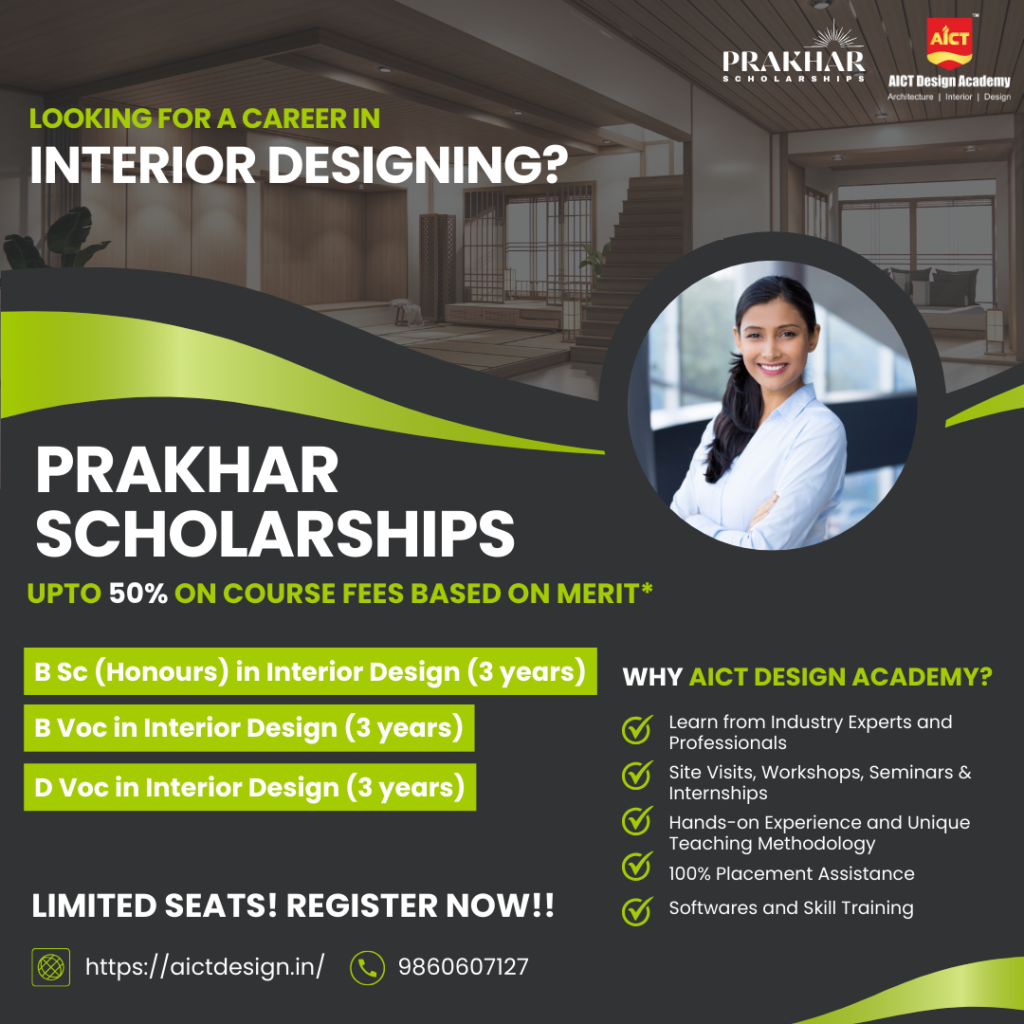
                The institute is also offering Prakhar Scholarship on their merit score to all the students, of upto 50% and girls are offered with an additional discount of 10% on tuition fees.

                This workshop will avail the students about interior design courses and the scope of interior designer in today’s competitive world.  

                Interior Designing new batch starting from 14th June 2024

                Interior Design

                Scope of INTERIOR DESIGN

                Interior design is one of the most sought after courses with excellent growth potential. The demand for qualified interior designers is rapidly growing as the industry offers a wide platform to the designers in order to exhibit their potential in the areas. such as hospitality, malls, multiplexes, showrooms, auditoriums, offices, residences etc. to name a few. Think of any space and it looks incomplete without a touch of an interior designer.

                Get in Touch with Us

                NATA Coaching in Pune and PCMC
                Prakhar Scholarships at AICT Design Academy in Pune

                Prakhar Scholarship for Interior Design

                Unlock Your Future with the AICT Prakhar Scholarship: A Golden Opportunity for 10th and 12th Pass Students

                Education is a powerful tool that can transform lives, and the AICT Design Academy is taking a giant leap towards making this transformation accessible to more students. We are thrilled to announce the launch of the Prakhar Scholarship, an initiative designed to support students who have completed their 10th and 12th grades. This scholarship provides a golden opportunity to enroll in UGC-recognized courses in interior design, a field brimming with creativity and career potential.

                Why Choose Interior Design?

                Interior design is more than just decorating spaces; it’s about creating environments that enhance quality of life and culture. With a growing demand for skilled interior designers in both residential and commercial sectors, pursuing a career in this field can be both fulfilling and lucrative. At AICT, we offer three meticulously structured courses that balance theoretical knowledge with practical skills, ensuring our students are industry-ready.

                Courses Offered

                    1. BSc (Honours) in Interior Design (3 years): Dive deep into the principles and practices of interior design with a comprehensive curriculum that covers everything from design theory to hands-on projects.

                    1. B.Voc in Interior Design (3 years): This course is tailored for those looking to blend vocational training with academic learning, providing a robust foundation in interior design.

                    1. D.Voc in Interior Design (3 years): Focused on developing specialized skills, this program is perfect for students aiming to enter the workforce with strong practical abilities.

                  Scholarship Details: Rewarding Academic Excellence

                  The Prakhar Scholarship is designed to reward hard work and academic excellence. Scholarships are awarded based on the previous year’s academic performance:

                      • >= 95%: 50% off tuition fees

                      • >= 90% & < 95%: 40% off tuition fees

                      • >= 80% & < 90%: 25% off tuition fees

                      • >= 70% & < 80%: 20% off tuition fees

                      • >= 60% & < 70%: 15% off tuition fees

                      • < 60%: 10% off tuition fees

                    Why Apply for the Prakhar Scholarship?

                        • Financial Relief: Significantly reduce your educational expenses, making quality education more affordable.

                        • Quality Education: Gain access to top-notch resources and experienced faculty who are committed to your success.

                        • Bright Career Prospects: Enter a field with a growing demand for skilled professionals and diverse career opportunities.

                      How to Apply

                      Interested students and parents can visit the official AICT website to learn more about the application process, deadlines, and required documentation. Our admissions office is also available to answer any questions and provide guidance through the application process.

                      About AICT

                      AICT Design Academy is one of the most renowned institutions in the field of Design and Education. It stands as a beacon of excellence and has been instrumental in shaping the careers of thousands of creative minds over the past two decades.

                      Our story began in 1997, with a passion for empowering students through technology. Over time, that passion thrived, leading us to expand into the dynamic world of design. Today, AICT Design Academy stands as a vibrant testament to the power of shaping the future through professional technological expertise and artistic vision, offering comprehensive training in architecture entrance exams, interior designing courses, and architectural and designing software.

                      Contact Information:

                        •  

                        Conclusion

                        The Prakhar Scholarship is more than just financial aid; it’s a stepping stone to a brighter future. By investing in your education today, you can unlock endless possibilities tomorrow. Don’t miss out on this opportunity to achieve your dreams and make a mark in the world of interior design. Apply now and take the first step towards a successful and rewarding career.

                        12th HSC Board Results 2024

                        12th HSC Board Results 2024: Check Your Scores Today at 1:00 PM

                        The wait is finally over for thousands of students across the state as the 12th HSC Board Results 2024 are set to be declared today at 1:00 PM. This much-anticipated announcement will determine the academic future of many young minds, guiding their next steps towards higher education and career opportunities.

                        How to Check Your 12th HSC Board Results 2024

                        To ensure a smooth and hassle-free experience, students are advised to follow these steps to check their results:

                        1. Visit the Official Website: Head to the official board website, which is the primary platform for result dissemination.
                        2. Find the Result Link: https://mahresult.nic.in/
                        3. Enter Your Details: Input your roll number and other required credentials.
                        4. Submit and View Your Result: Click the submit button and wait for your results to be displayed on the screen.
                        5. Download and Print: It’s recommended to download and print a copy of your results for future reference.

                        What to Do After Checking Your Results

                        1. Verify Your Details: Ensure that all the information on your mark sheet is accurate. Check for any discrepancies in your personal information and subject-wise marks.
                        2. Collect Your Mark Sheet: Schools will provide the official hard copy of the mark sheet a few days after the results are declared. Make sure to collect it promptly.
                        3. Plan Your Next Steps: Based on your results, you may need to make important decisions regarding your higher education. Whether you are applying for college, vocational courses, or competitive exams, it’s crucial to start the application process early.

                        Dealing with Unexpected Results

                        Not every student will achieve the results they hoped for. Here’s what to do if your scores are lower than expected:

                        • Re-evaluation: You can apply for re-evaluation or rechecking of your answer sheets if you believe there has been a mistake.
                        • Supplementary Exams: Boards often provide the option to sit for supplementary exams to improve your scores.
                        • Career Counseling: Seek guidance from career counsellors to explore alternative educational and career pathways that align with your interests and scores.

                        Final Thoughts

                        The release of the 12th HSC Board Results 2024 marks a significant milestone in your academic journey. Regardless of the outcome, remember that this is just one step towards your future. Stay positive, explore your options, and pursue your passions with determination.

                        For more updates and detailed information about the 12th HSC Board Results 2024, keep visiting our blog. Good luck to all students!

                        updates about Architecture

                        Admissions 2024 are open for Bachelor’s in Urban Design Program

                        CEPT University

                        Admissions 2024 are open for Bachelor’s in Urban Design Program

                        Apply with National Aptitude Test in Architecture (NATA)

                        Apply Now: https://admissions.cept.ac.in/cept-adm-login.php

                        For Admission Enquiries

                        Email us at admissions@cept.ac.in

                        Website: admissions.cept.ac.in